How Do Modern Farms Use Resources More Efficiently?
Farm efficiency is no longer measured only by the amount of production achieved at the end of the season, but also by the amount of resources required to reach that result.
Farm efficiency is no longer measured only by the amount of production achieved at the end of the season, but also by the amount of resources required to reach that result. As the cost of water, energy, fertilizers, and labor rises, along with increasing pressure on natural resources, improving Resource Efficiency in Agriculture has become an essential part of developing modern farms.
The idea is not to use fewer resources randomly, but to achieve the best possible result from the available resources while preserving the farm’s ability to produce in the future.
This concept is particularly important in date farming because date production depends on a broad set of inputs and operations that extend over many years. Water management, soil health, nutrition, energy, labor, and agricultural operations all affect production cost and stability. Therefore, Efficient Farming has become more closely connected to how these elements are managed together, rather than simply reducing the consumption of one of them.
In its recent directions on Smart Farming, FAO indicates that using data, technology, and precision agriculture can help farmers improve the management of resources and agricultural inputs and increase production efficiency.
What Does Resource-Use Efficiency Mean in Agriculture?
Resource-use efficiency does not mean that a farm using less water or fertilizer is necessarily more efficient. If reducing water stresses the trees and lowers production, or if reducing fertilizer weakens growth and production, then reducing inputs does not represent a real improvement. The most important measure is the relationship between what is used and what is achieved in return.
For this reason, modern agriculture uses concepts such as Water Productivity, Nutrient Use Efficiency, and Energy Efficiency to measure the relationship between inputs and results. Instead of asking only: How many liters of water did we use? The question becomes: How much production did we achieve in return for the water used? The same idea applies to fertilizers, energy, labor, and other resources.
This shift from measuring consumption to measuring efficiency helps farm management make more realistic decisions instead of seeking to reduce figures without considering the effect on production.
How Can Water-Use Efficiency Be Improved on Date Farms?
Water is one of the most sensitive resources in date farming, especially in arid and semi-arid environments. However, improving Water Use Efficiency does not mean establishing one irrigation rule and applying it to all date palms, because tree needs are affected by different factors such as climate, soil type, palm age, growth stage, irrigation method, and water quality.
Water efficiency therefore begins with understanding the farm’s actual needs and then determining irrigation timing and quantity based on those conditions instead of relying on fixed estimates that never change.
In Egypt, this issue is even more important because of limited water resources and climatic conditions. An FAO study on Egypt’s date sector indicates that improving irrigation systems can significantly increase water-use efficiency. Recent FAO programs for Egypt’s palm sector also focus on efficient irrigation and improving Water-Use Efficiency as part of improving productivity and fruit quality.
Why Is Soil a Long-Term Productive Asset?
Soil is not merely an area in which date palms are planted; it is part of the production system itself. Its ability to retain water, provide nutrients, and support root growth is affected by how it is managed over many years.
For this reason, any problem related to salinity, drainage, or soil-structure degradation can gradually develop from a limited problem into a factor that affects the productivity of the entire farm.
In date-palm farming, soil management requires considering the relationship between land characteristics, water, and nutrition. More irrigation, for example, does not necessarily create better conditions for roots, and using fertilizers without understanding soil characteristics may lead to incomplete utilization.
Therefore, Soil Management on modern farms aims not only to preserve the land, but also to preserve its productive capacity over the long term.
How Can Fertilizers Be Used More Efficiently?
Fertilizers represent a significant cost in agricultural operations. Efficiency therefore does not come from consistently using a larger or smaller quantity, but from directing nutrients according to the needs of the plant and soil.
Differences between areas within the same farm may make applying the same amount to all trees unsuitable in some cases.
This is where Precision Agriculture plays a role. It allows more detailed information about the soil, plant, and agricultural conditions to be used when making fertilization decisions.
In modern practices, soil analyses and agricultural data can help determine what the plant actually needs, thereby reducing unnecessary use and improving Nutrient Use Efficiency.
Recent research in precision agriculture shows increasing interest in linking soil, water, and weather data to irrigation and fertilization decisions instead of relying on uniform schedules for every part of the farm.
Where Does Energy Fit into Farm Efficiency?
Energy is different from water and fertilizers, but its cost is connected to many operations within the farm, beginning with pumping water and operating irrigation systems and extending to equipment operation and other activities.
Improving Energy Efficiency in Agriculture is therefore not only about choosing more efficient equipment; it is also about understanding where and why energy is being consumed.
For example, improving an irrigation system may affect energy consumption because the amount of water that needs to be pumped, transported, and distributed changes. The way equipment is operated, the number of working hours, and maintenance can also affect total energy consumption.
Energy management therefore needs to view agricultural operations as an interconnected chain rather than treating each piece of equipment as a separate element.
How Does Data Help Identify Where the Problem Is?
Data does not reduce resource consumption on its own, but it makes farm-management decisions more measurable and reviewable.
When the farm knows the amount of water used, the timing of operations, production, climatic conditions, and other important information, it becomes possible to compare results and identify what actually changed.
This is where the value of Farm Data lies. If the irrigation program is modified, results before and after the change can be compared. If the fertilization method changes, its impact on production can be monitored. If a different practice is applied to one part of the farm, its results can be compared with other areas.
In this way, data changes from simple records into a tool for learning and improving decisions in subsequent seasons.
In its recent directions on Smart Farming, FAO confirms that data and technology have become part of developing agricultural systems that use resources more efficiently, with an emphasis on information-based decisions rather than using technology merely for its own sake.
Do All Parts of the Farm Need the Same Treatment?
Not all areas of a farm are necessarily identical. Soil characteristics, tree condition, production levels, or local conditions may vary within the same farm.
Therefore, applying one decision to all trees may not always be the most accurate way to manage resources.
This is one of the foundations of Precision Farming: moving from uniform management to management that accounts for differences within the farm.
With the development of soil mapping, remote sensing, and data-analysis technologies, it has become possible to obtain a more detailed picture of spatial differences within agricultural areas.
The goal, however, is not to turn every palm into an independent project, but to reach an appropriate level of detail that helps management direct resources and decisions to the places that actually need them.
How Can a Farm Reduce Waste in Time and Labor?
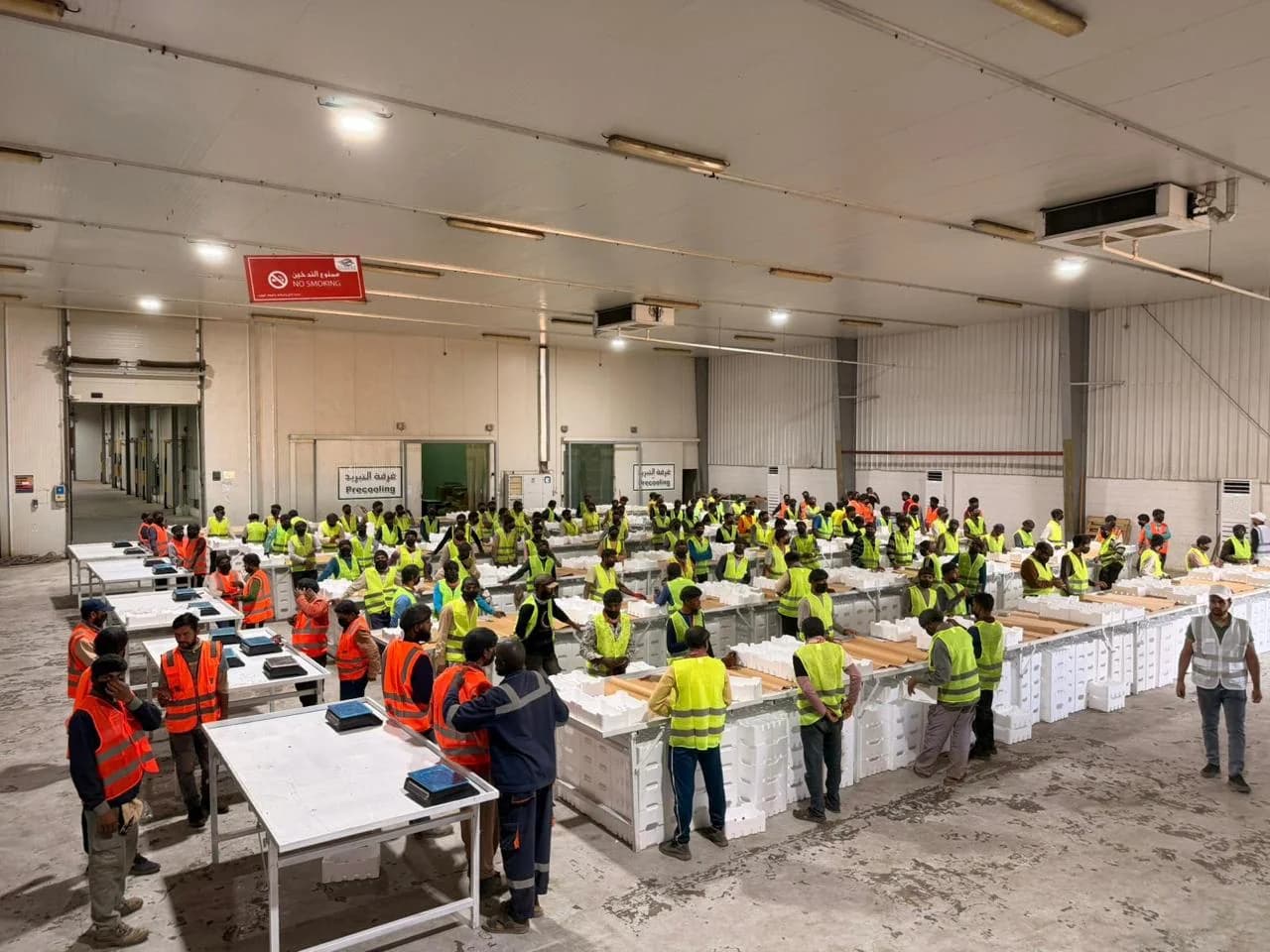
Resource efficiency is not only about water, fertilizers, and energy. On large farms, time and labor represent an important part of operating costs, especially when repeated operations require collecting information, recording data, or monitoring a large number of trees.
Digital systems can help organize information and reduce repetitive administrative work, while human expertise can be used for tasks that require actual assessment and decision-making.
This does not mean replacing the worker or agricultural engineer with technology. It means distributing effort more efficiently so that human expertise is used for tasks that add greater value.
As the farm expands, this point becomes more important, because a method that works well with a limited number of trees may become slow and expensive when production volume doubles.
How Can a Farm Detect Waste Before Trying to Reduce It?
Sometimes the first wrong decision is to try to reduce consumption before identifying the source of the waste.
If a farm is using more water than required, the solution is not necessarily to reduce water immediately. The problem may be irrigation scheduling, distribution efficiency, or soil conditions.
If fertilizer consumption is high, the problem may be the method used to determine needs rather than the amount of fertilizer itself.
Therefore, Resource Efficiency in Agriculture begins with analyzing operations:
- Where is the resource being used?
- Why is it being used?
- What result does it achieve?
- Where can loss occur?
These questions help management move from general decisions such as “reduce water” or “reduce fertilizer” to more precise decisions such as changing the method, timing, or distribution of the resource because the data indicates waste at that stage.
What Is the Role of Technology on a Modern Farm?
Technology is not an additional resource that should be used simply because a farm wants to appear modern. Its real value appears when it helps solve a clear problem or improve a specific decision.
For this reason, Smart Farming can include a wide range of tools, such as farm-management systems, remote sensing, weather stations, sensors, data analysis, artificial intelligence, and precision agriculture.
However, choosing the right technology should begin with the farm’s needs, not the other way around. A farm that needs to improve irrigation scheduling does not necessarily need the same tools as a farm facing a problem with operation traceability or soil-variation analysis.
Successful Digital Agriculture is therefore the kind that connects technology to a real production problem and can measure whether the tool used has achieved an actual result.
Why Does Resource Efficiency Not Mean Reducing Inputs at Any Cost?
Reducing consumption may look like success on paper, but agriculture is ultimately measured by the result as well.
Reducing water while production declines is not necessarily an improvement, and using less fertilizer while crop quality deteriorates is not necessarily more efficient.
The goal of Efficient Farming is therefore to achieve a balance between productivity, cost, resource use, and sustainability.
The experiences discussed by FAO in Egypt show that climate-smart agricultural practices can combine improved productivity and income with a greater ability to face climate change. These experiences have included the date sector.
Why Is Resource Efficiency Becoming More Important in Date Farming?
Palm cultivation differs from many annual crops because trees represent a long-term investment. Therefore, decisions related to water, soil, nutrition, and management do not affect only one season.
Any deterioration in the farm’s basic resources can affect its productive capacity for years to come.
This makes Sustainable Date Farming directly connected to long-term management.
In Egypt, where agriculture faces pressures related to water, climate, and natural resources, improving input-use efficiency becomes part of preserving production continuity, not merely a way to reduce costs.
FAO indicates that Egypt faces challenges related to the efficient use of land, labor, water, and energy, along with the effects of climate change. The date sector itself is also among the sectors in which climate-smart agricultural practices have been tested.
What Is the Relationship Between Resource Efficiency and Tracking the Palm’s Journey?
Another aspect of modern management is the farm’s ability to know the history of production, not only its final result. This is where Traceability comes in.
Tracking the palm’s journey can provide a more detailed level of information about the product’s source and production history. This is particularly important when dealing with a long-term crop such as dates.
It is important, however, to distinguish between traceability and resource efficiency: Traceability does not make a farm more efficient automatically, but it provides information that can help in understanding and managing the production journey better.
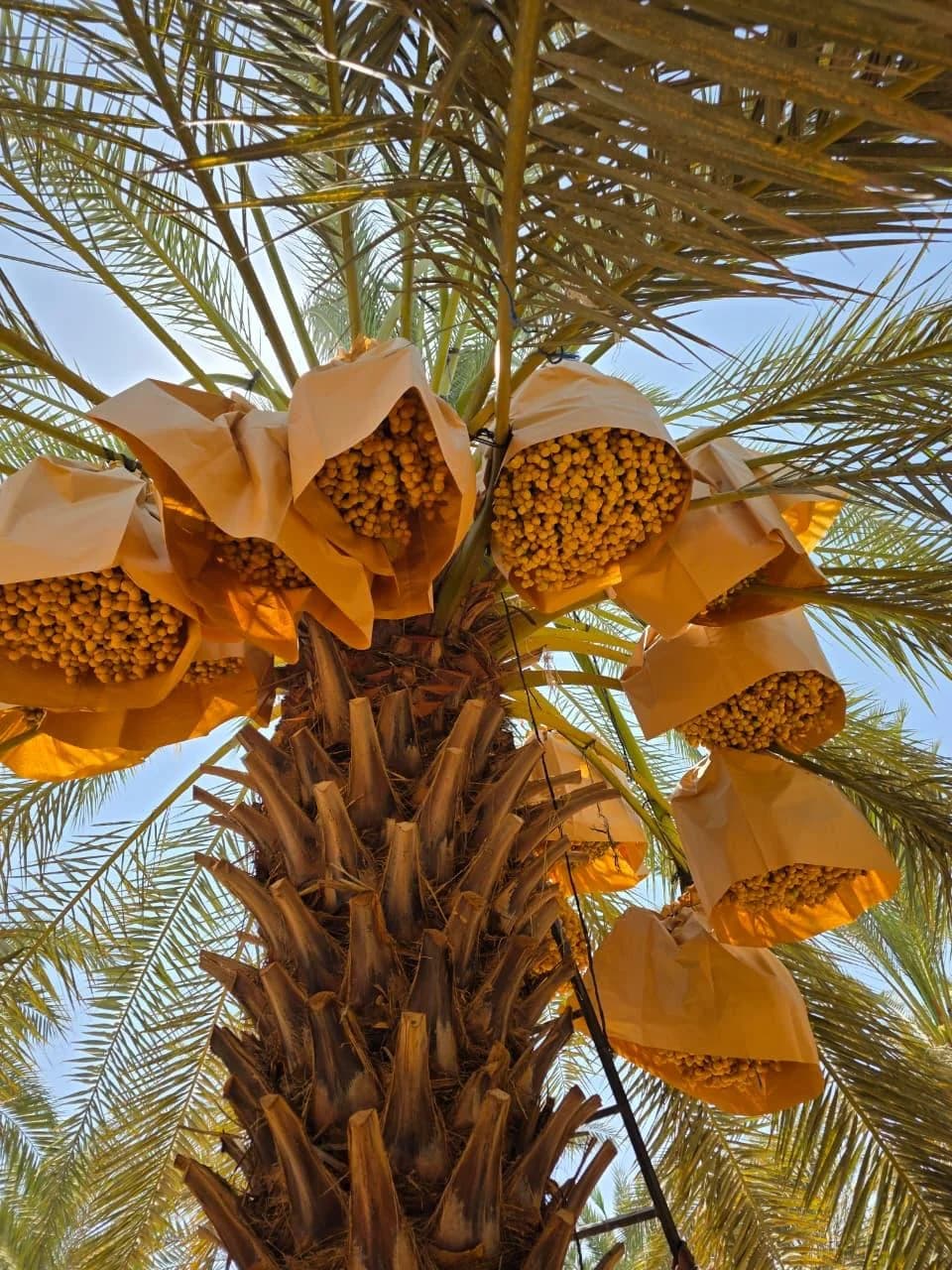
This is one of the features of MAP Trade Farm, where every palm is tracked from planting through harvest. This level of traceability makes the production journey clearer and gives the product a source that can be consulted, rather than limiting the buyer’s knowledge to the name of the farm or production region.
For commercial buyers, this visibility can be important when evaluating a supplier, understanding the product’s source, and understanding how production is organized, especially as interest in transparency and traceability within food supply chains increases.
How Does a Farm Benefit from Resource Efficiency Over the Long Term?
The real result of resource-use efficiency does not necessarily appear in one decision or one season.
When a farm begins measuring its operations, understanding its consumption, and comparing results, it builds a knowledge base that can be used in subsequent seasons.
Efficiency improvement then changes from a set of separate decisions into a continuous process: measure, analyze, apply, compare, and improve.
Every season provides new information, and every piece of information can help management make a more accurate decision in the next season.
This is the direction toward which modern agriculture is moving: not only producing more, but building systems capable of using resources more efficiently and flexibly as conditions change.
FAO currently places Smart Farming and resource-efficient production at the center of discussions about the future of agricultural systems, with a focus on using data and technology to improve production while managing resources better.
The Most Efficient Farm Is Not the One That Uses the Least Resources
Ultimately, Resource Efficiency cannot be reduced to the number of liters saved or the amount of fertilizer reduced.
Real efficiency means that the farm knows its resources, understands its needs, measures the results of its decisions, and then uses this information to reach the best possible result while preserving its productive capacity for the future.
This is what makes resource-use efficiency broader than simply reducing costs. It is a way of managing the farm based on understanding the relationship between production, water, soil, energy, fertilizers, labor, and data, and then continuously improving that relationship.
At MAP Trade Farm, this focus begins with knowing the palm’s journey itself. Tracking every palm from planting through harvest provides visibility and documentation about the product’s source and production journey, adding a different dimension to the idea of transparency in date production.
The future of agriculture will not depend only on possessing more resources, but on knowing how to use them more accurately, efficiently, and sustainably.
Contact us today to learn more about available dates, supply specifications, and quantities suitable for your needs. (MAP Trade phone number)